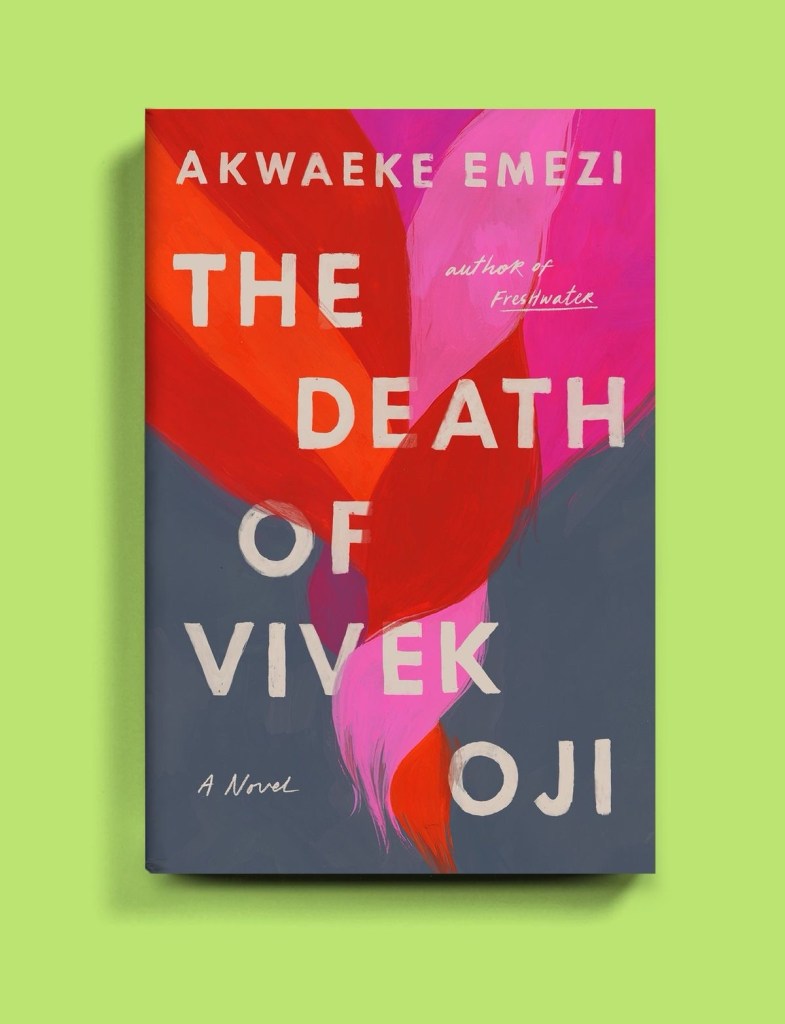
The Death of Vivek Oji by Akwaeke Emezi

Akwaeke Emezi writes from a place I can only describe as home. Her prose is soulful and immersive; it pulls you into the pages until you find yourself living alongside the characters, inhabiting their bodies, their fears, their desires.

In The Death of Vivek Oji, I saw a boy. I saw a girl. I saw a human being trying to exist in a world that allowed no room for difference. I witnessed how friendship became a shield, how friends protected a child who only wanted the freedom to express himself honestly. They held his truth and allowed him the peace to live. The peace he never found elsewhere.

Nnemdi was Vivek, and Vivek was Nnemdi. She was Nnemdi when she needed to be, and Vivek when he needed to be. Through her, I saw the power and mystery of reincarnation. Growing up, I was told my grandmother was the daughter of a relative who had promised to return. As a child, she reportedly went to that relative and introduced herself, bearing the same birthmark as the deceased. Seeing Ahunna reappear in Vivek stirred similar questions for me. Was she unfinished with life, or was she drawn back by her longing to be with her sons again? What compelled her return? And when she spoke through Vivek, asking about her yam barns, what exactly was she searching for?

The emotional weight of the book rests heavily on Osita. How does one person carry so much grief and guilt, yet remain steadfastly devoted to Vivek in such dual, complex ways? His lover and his cousin. I saw Elizabeth. I saw the quiet intimacy of a shared life. Vivek’s deepest friend. I saw love. And in Kavita, I witnessed raw vulnerability, she was just a girl, how could life be so cruel as to take away the one person who brought her true joy? I love the Nigerwives and the allegiance they have for one another.

Vivek Nnemdi Oji.

For Chiamaka in Dream Count.

You found love in a human who chronically despises you. He is jealous of you, hates your guts, your beauty, your background, your influence, and how easily you settle into your “job” as a travel writer.

“Is it still travel writing when you travel in luxury?” he asked one time.

What you feel for him is not love, it is the desire for shege banza—the kind that is a shrinking of yourself to allow him to glow; a fearful retreat of your spoken words to avoid offending him; a forgetting of yourself.

Emmanuella.

It is walking on eggshells. You are not allowed to touch his phone, and you’re too fearful to confront him about the texts he receives, the ones that make him storm out of the house even after making serious plans to be together.

His name is Darnell. And you, Chiamaka.

The same Chiamaka whose mother is a peacock. Beautiful, proud, and gutsy. She holds her shoulders high and forgets to be the Nigerian kind of humble.

Who did you take after? Not your papa, who built wealth from the sales of palm oil, bold, rich, and daring. And obviously not your cousin, Omelogor, who, after dinner with you and Darnell, says, “You hide your worth with him.”

Because you really do. You forget to stand up for yourself or even respect yourself.

Why should you be afraid to look eye-to-eye with the man who sleeps with you? A man who makes you feel beneath him, undeserving of even a compliment from a stranger.

When the airport official said something miraculous about your eyes and you blushed too much, because you’ve been starved of attention, he said, “It’s common.” That you should already know your eyes are beautiful.

You try to express your feelings, and he hushes you with, “You’re hormonal,” as if your body were a mistake. As if it fails to function the way he wants.

He says, “Get a grip of yourself. We’re outside.”

But you sit there and smile through the embarrassment, the belittling of yourself. You laugh the disgrace off and wish you could change him. That he would make you feel better. That he would appreciate your writing and the you who is rich, has a house-help, and can book expensive flights.

For a man who went ballistic because you ordered a mimosa in a French restaurant?

Ọ na-apụ ara?

How do you forget to be a woman, even when the example of one sits in your mother?

Affymma

I have become the people

I once saw at the top—
Those with crisp loins, buttered tongues, and pride sharp as blades,
They, who made it seem like my first-generation self would stretch too long to get here.


Hah!

Pintrest


Me? Emmanuella. My name, so long, surprises you I stuck around?
I stayed, pushed hard until my knowledge became so palpable,
You couldn’t turn a blind eye.

I stuck around for a day like today,
Where I wear my grandmother’s name with pride—Affymma, Affiong ete!
Affymma, from generations rooted in life and immortality,
Sprouting breaths of beauty and vitality.


Me? Affymma, who danced kokoma on bare feet,
Swung her waist to the dim dim drums made of leopard skin.

Now, I sit at tables once reserved for those I admired—
Bold. Rich. Audacious. Intelligent.
I occupy spaces once unwelcoming,
And I crush the tables of restriction.

Remember I came home with emotions flagged red from your microaggressions,
Questioning myself, doubting if how you treated me was right.
I beat myself up for not standing firm,
Never see it coming when you pour out your maltreatment.
But see me now—
Triumphing, one day at a time.

I am the woman who now sits beside you in Ankara dress,
Capped in a black bob wig, draped in the richness of my skin.
I am Affymma, the risen star.
And just like you, I am now at the top.

Becoming Black…

I became “black” the day I stepped foot in Ala bekee~ UK. It was the winter of 2021. The clouds formed light-grey, thick fluorescent sheets that descended onto the roads, engulfing cars as they drove through. I would soon come to know this phenomenon as fog. 

Away from home and everything that had been familiar,  I decided to pretend my body was at Obudu Cattle Ranch, a small village in Cross River state-Nigeria where the cold isn’t as freezing as the insides of the beecheve women’s freezers, where their ice fishes lived in deep cold, and their fingers would go numb from sorting through mackerel to sell.

Two weeks after my arrival, I was referred to as “black.” I had met Margaret, a middle-aged British woman who thought leaving home and coming to the UK was the bravest thing anyone could do. I smiled a lot during our conversation because I didn’t know if my presence in the country was truly an intelligent move. I had left home, left my job as a nurse, and abandoned everything familiar. Here I was, starting all over again, alone and feigning bravery.

I cried often, battling to understand my patients, figuring out that sachet was pronounced “sa-shay”, saying “you are alright “ as “U’right?” and learning that when a health assistant said a patient was feeling sick, they meant nauseous. It took a while to understand that “going to spend a penny” meant going to the toilet. Have I ever been bold enough to tell anyone about my struggles with understanding those humans on the other end of a  telephone call? Updating patients relative about their loved one on the telephone and I going “could you say that again “ multiple times. Why would someone say I spoke too fast and needed to slow down? In my country, my English was plain—no big words, just simple and clear. But they didn’t understand me, and I didn’t understand them either. But I have spoken English since I started primary school in Nigeria.

Margaret’s email to me sealed the identity shift. It was a friendly message, suggesting how the neighborhood would like to support “the black immigrants like yourself…”. In my country, I am Efik, but I speak Igbo with the same fluidity as my mother tongue. I was not black; I was either Igbo, Hausa, or Yoruba. The consciousness of my skin color was simply about keeping it smooth and layering palettes of Mary Kay on my face.

Now, I found myself far from the large clan of people who shared my skin color and in a land filled with people from all walks of life. It was here I learned that October is Black History Month, where attention is paid to the accomplishments of Black people. Their contributions in various industries are celebrated, and it is an opportunity to foster community, promote diversity and inclusion, and encourage allyship to fight against discrimination and racism.

It was here I learned about the Windrush generation and the Windrush scandal of 2018, more about slavery, a bit more about colonialism, and my roots. A patient once referred to me by a racist slur. Did I cry that night? Yes. I walked home in the cold, sobbing uncontrollably, regretting my choice to migrate for the first time.

But it wasn’t just strangers. I also learned that sometimes, your kind can lead you to the path of sacrifice. I met a fellow nurse with the same skin as mine, but her joy seemed to be in watching me fail. She consistently talked down on me in front of other colleagues. I had heard of the divide-and-rule tactic, where one Black person is used as a tool against others. Do I call her behavior racist? The pain was the same.

The NHS Workforce Race Equality Standard (WRES) reports that Black, Asian, and Minority Ethnic (BAME) staff make up about 24% of the NHS workforce. Yet, we are underrepresented in senior leadership roles. As of recent reports, only about 6.5% of NHS board members come from BAME backgrounds, even though the workforce is much more diverse. As a person of color, I approach job interviews with a fight mentality. I prepare thoroughly—studying broadly, rehearsing every necessary experience relevant to the role, and repeating corporate English in my head multiple times before voicing it out loud. I do informal visits to units, declare a harmless interest in roles, then commit everything to God.

Still, sometimes, just like an interviewer once told me, “You were absolutely amazing. Everyone loved you, but we were hand-tied. We had to give the role to someone already on the team.” That day, I stood in front of the mirror, stared into my own eyes, and wondered how a job was reserved for someone, yet a full panel of interviewers wasted my time. Chineke nna’m!

But I am Black. I am a woman. I am a nurse. And I have a place here.

Who would relate best to that Black patient whose catheter isn’t draining? Who would understand the woman in labor, whose pain is overlooked because she’s seen as strong? Cultural competence is everyone’s responsibility especially in health care but Where you cannot stand, I might be able to.

Black History Month serves as a reminder of both the progress that has been made and the work that remains. It is a time to celebrate the achievements of Black people, not only in the UK but globally, and to recognize the invaluable contributions we make in every industry. Yet, we must also use this time to advocate for systemic changes—more Black nurses in leadership, pay equity, and the eradication of discrimination in healthcare.

Emmanuella.

Book Review: The middle daughter by Chika Unigwe.

The first time I saw grief drive a person mad was in Amakohia, a small vicinity in Owerri. I had just gone from bathing in front of our house to putting Vaseline on my tiny lips as makeup. The person was Mama Uche. Some people had brought the news that her husband, a police officer who returned home every weekend with a gun strapped against his back, had been killed by kidnappers who invaded the house he guarded.

Mama Uche went from laughing loudly to stripping off her clothes, almost running into the street. Even months after her husband’s burial, you would still find her wandering around the Maami market. Grief.

It was the same grief that exposed Nani to Ephraim in Chika Unigwe’s The Middle Daughter. First, it was Udodi, her elder sister, who died, then Doda, her father. The once beautiful family of three girls and loving parents withered like the flowers in front of the house did when Nani wouldn’t return from Ephraim’s.

Grief sucks you into a place of darkness and breathlessness, making you blind to imminent danger—a danger like Ephraim, who is patriarchal, a religious fanatic, and a woman beater. He deceived Nani into marrying him, and her life spiraled into a world of gloom and doom. Number 47 in Enugu, where she once dreamed of going to America, becoming a doctor, opening a private hospital, and marrying the love of her life, became Obiagu a place where she merely fulfilled Ephraim’s demands and nearly lost everything.

I love how Chika Unigwe infused Igbo poetry and proverbs into her book. Udodi’s choruses were beautiful to read, and I appreciated how the characters told the story themselves. It was engaging. However, it was written in both first and third person, and if you’re not careful, you might not notice when the voices switch. I read the book in three days but almost abandoned it on the second day when I began to grow angry at Nani, and perhaps at the author.

Why would a girl who grew up in middle-class wealth in Enugu endure such maltreatment, all because her mother made money in a way she didn’t like? Her busy schedule? The day Ephraim branded her face with a hot iron after a brother looked lustfully at her in church should have been enough for her to return home. Ephraim raped her, got her pregnant, and all she could do was not run to Aunty Enuka but her abuser? Teenagers will be teenagers, but what about the adults? Her mother didn’t want to be associated with her, never looked for her, and no relatives questioned Ugo for information? How could an entire family let go of a young woman like Nani?

I finished the book because, despite my anger, my heart still ached for Nani. Three children later, her life took a different direction.

Grief sometimes breaks us into pieces we don’t recognize, makes us vulnerable, and clouds our vision. I’ve learned to anchor myself with loved ones. I may be in pieces in their sight during my grief, but no one will break any piece of me in such times. And when healing comes, they will help sculpt me back into shape.

The book in my hand.

Anulika

Dear Anuli,

When you introduced Okosisi to me, you didn’t call him a mortician; you said he was one of the men with an office behind our health centre. You didn’t say that this udara ocha with irises the color of the sun had his hands in a business I fear?

There are two offices behind the Umuora health centre. One is the one Mma calls “officili,” where we send our breathless relatives to find soothing until the monies we task ourselves are complete for a funeral. The other one is Dr. Odumu’s office, a mini private clinic. I hear he is sent youth corpers every year from Enugu—corper doctors. So when you said Okosisi works behind the health centre, my mind didn’t run beyond what you told me. I held firm to my thought that he was probably one of those doctors they sent from Enugu.

Nwanne, Okosisi has dug my insides with his fingers. The same fingers have made me water recklessly, and with those same fingers, he spread my labia open and drank from my juice. I forgot my home training the night he had me trapped under his masculinity. I behaved like an Akunakuna; I licked the very fingers he dipped inside me, and rolled my tongue across his broad chest. The night was a good shield, who would have believed I would satisfy a man that tall? 

Anuli,  the same fingered that filled me are the same ones that have laddered the bodies of those we will no longer see?

Chai Chineke nnam ooo!

I hear they never wear gloves, that they tear up femoral arteries with bare hands and feed the bodies with formaldehyde.

Anulika, idi very wicked.

How do I move on with life knowing that I have shared my insides with a man who cares for our long-gone relatives without even a pair of gloves? 

Read this letter with your legs in my shoes. Don’t you dare roll your eyes because you tricked me.

Anuli, idi wicked.

Emmanuella.

Brows and Life

I wasn’t fortunate enough to have my fingers master the art of brow drawing when girls clustered in circles, having their brows carved and learning the tricks of perfecting angles and curves.

Try as I try, e no gree me learn.

Emmanuella.

That morning, two hours before the start of an eight-hour shift, I sat in front of my mirror, ready to wear a near-perfect brow. They say it is best to start drawing from below, that the arch is easily formed that way. So, I plunged, holding my breath and rolling my face to the drive of the eye pencil.

With every draw came a wipe. I saw my mistakes, and my mind said: “No too draw am fast, take am sofrisofri.” Time was ticking, just as it was ticking for Mama Bomboy. What she didn’t know was that, for every minute she wiped her vagina, I wiped my brows too. While it was ignorance for her, it was just a mistake for me.

I sharpened my eye pencil more, peeling height from it and wishing the tip would do the magic. Mama Bomboy was home, dripping wet from the flow of amniotic fluid and wishing it would stop. She poked her hand into her vagina and noticed green stains.

“Na shit be this?” she wondered.

The baby was in distress, just like the skin around my brows.

With 20 minutes to work time, I dumped my eye pencil. I no gree die. Wetin street no tish you, YouTube dey. Brows unfresh, I walked into the labor unit. On the couch was Mama Bomboy pushing an already blue baby.

She spent time. She wasted time. I spent time. I wasted time.

It cost me redness around the skin that holds my brows. It cost her Bomboy.

Time!

Bland kiss

…a few months before I turned 17, I noticed I had cultivated an intense but gradual love for music. Not the regular sounds that blast through the speakers of a barbershop but slow, soothing songs that were usually played by radio stations at night, only interrupted by phone calls from listeners lending their voices to a relationship issue.

I did not listen to those songs because I was beginning to enjoy singing or because the lyrics touched my soul. I listened because the melody played effectively with my imagination, and the lovers’ quarrels reported on the radio flourished the vision of my mind’s eye. At that time in my life, my secret desire was to be kissed. So, with music from the stereo, my mind ran through the scene of having my face cupped in a masculine grip, then some soft lips would run over my already itching mouth, locking tongues and devouring the sweetness of our saliva. Music was my succor. I was a teenager; everything conspired to cause turbulence in my emotions.

Photo by Andrew Eslebo

When I eventually got kissed two years later, it was nothing like I had ever imagined or seen. It was bland. After night class that day, when students retired to their hostels, my boyfriend held my hand and walked me through a field that led to my hostel. We were supposed to do a simple hug and bid each other goodnight, but somehow our lips met and we kissed. A short, simple, and dry kiss. It ended too quickly. We were too shy to say any words, so we left immediately. It was without the sweet taste I expected; it didn’t have us inhaling our heated breath or me closing my eyes to enjoy my tongue being licked. It lasted less than a second, and it went like “muah!”—like my mama was running behind us holding a garri turner and we just had to kiss fast.

That kiss didn’t match the music that played from the stereo, especially when I had fantasies of being kissed to Celine Dion’s “Every Night in My Dreams.” My first kiss was empty, it was rushed and it tasted of “nothingness”.

Akaliza

You are English, and your wife is a stunning black woman from Rwanda. You met her after your terrible breakup with Eileen. Family advised you to go on a solo trip to “find yourself,” to love yourself, to journal, maybe even begin a podcast, and to look inward for that twinkle of light that could just spark something in your mood-swinging, bed-laying, junk-eating life.

Akaliza brought you that light, and you have never stopped telling anyone who cared to listen that you met your wife on a flight from the UK to Rwanda, the country of a thousand hills.

Akaliza

Your first kiss was breathtaking; you buried your tongue into hers as if your existence depended on her lips for survival. You arched your neck to the right, pulled her by the chin, and savored the sweetness in her mouth. Akaliza is soft and welcoming; she shut her eyes and pushed her petite frame into you.

And the day you popped the question, You rented a yacht, gathered friends onboard and had her favourite music in the background. you gave her a cocktail of happy emotions, it made her contemplate between smiling, screaming ,laughing or crying. She chose the easiest, tears. She bursted out in tears and cried with pure joy.

Her fingers shook in excitement when she stretched them out for the ring.

“2002” by Anne-Marie made the atmosphere right for you, you combed her in an embrace, and just kept your eyes glued on this woman who you will climb many mountains for, this woman in whose life you see yours.

You have your heart buried in the beauty of this woman, Akaliza.

Funmilayo Ransome Kuti Movie Review

Mama Funmilayo Ransome-Kuti was a woman of many firsts. I met her in the pages of our primary school “Current Affairs” as the first woman to drive a car in Nigeria. She was also the first female member of the Nigerian Union of Teachers, the first African woman to become a member of the Commonwealth Parliamentary Association, the first Nigerian woman to receive the Lenin Peace Prize, and the first female student at Abeokuta Grammar School.

Seeing her bravery displayed on screen as documented history is beautiful to watch. Every scene was intentional, carrying with it the heartbeat moments of a rich, strong, and beautiful African woman. I can’t help but give a million roses to Kehinde Bankole, who somehow became Mama Funmilayo in flesh. Did we see the grace and poise in how she carried herself? The stern boldness in her face? And the sound of her voice when she spoke? Did we hear her cracked voice from screaming and cheering the Egba women? Kehinde Bankole was IT.

The film.

The movie showed the life of Mama Funmilayo Ransome Kuti without the temptation of diving too much into other aspects, like the life of her children, and I love how all the attention was on her. The story is about young Frances, who later became Oluwafunmilayo, meeting and marrying her secondary school lover, Israel. It chronicles her career as an educationist and the establishment of the Abeokuta Women’s Union, a platform she used to advocate for women’s rights, fight unfair taxes on market women, and demand the representation of women in government.

I love the gentle chemistry between Ibrahim Suleiman, who played Israel, and Kehinde Bankole. He was a huge supporter and influence on Funmilayo. The director of this film, the brilliant Bolanle Austen-Peters, did a fantastic job. Every scene interpreted a message and was depicted in a striking way. The first scene of the chaos that led to the throwing of Mama Funmilayo from the second floor of her son’s house caught my attention, then it gradually drew me in. The acting was great; I could relate to the actors, especially in the interpretation of their script. The sound was crisp and clear, and I love that we used our songs to interpret moments. The scene where the Egba women launched into the palace and retrieved the staff of office could have been depicted more realistically. The blows did not seem to land on the guards’ faces or bodies, the women carried no weapons, and the guards didn’t put up a good fight. I would have expected Kehinde and the entire group of women to pounce on the chief guard, engage in some real fighting, and destroy the palace. Abeg ooo 😂

This movie brought the memories of Mama Funmilayo alive, and I could see how selfless and strong she was in the face of pressure and oppression, yet she stood firm. I have also read about her, and I see how dynamic she was and the many roles she played as a woman in her lifetime. I recommend this movie and give it a 9.5/10. No! Scratch that, not with the way the beautiful Kehinde Bankole slayed those Ankara outfits and the scene where she addressed the king with so much authority, stating what the women wanted. The clap back at the king? Stellar! It’s a 10/10.